# Standalone Activities - Java SDK
> Execute Activities independently without a Workflow using the Temporal Java SDK.
> **Pre-release**
[Standalone Activities](/standalone-activity) are Activities that run independently, without being orchestrated by a
Workflow. Instead of starting an Activity from within a Workflow Definition, you start a Standalone
Activity directly from a Temporal Client using `ActivityClient`.
The way you write the Activity and register it with a Worker is identical to [Workflow
Activities](/develop/java/activities/basics). The only difference is that you execute a Standalone
Activity directly from your Temporal Client.
This page covers the following:
- [Get Started with Standalone Activities](#get-started)
- [Define your Activity](#define-activity)
- [Run a Worker with the Activity registered](#run-worker)
- [Execute a Standalone Activity](#execute-activity)
- [Start a Standalone Activity without waiting for the result](#start-activity)
- [Get a handle to an existing Standalone Activity](#get-activity-handle)
- [Wait for the result of a Standalone Activity](#get-activity-result)
- [List Standalone Activities](#list-activities)
- [Count Standalone Activities](#count-activities)
- [Run Standalone Activities with Temporal Cloud](#run-standalone-activities-temporal-cloud)
> **📝 Note:**
>
> This documentation uses source code from the
> [standaloneactivities](https://github.com/temporalio/samples-java/blob/main/core/src/main/java/io/temporal/samples/standaloneactivities)
> sample.
>
## Get Started with Standalone Activities
Prerequisites:
- **Java** 8+
- **Temporal Java SDK** (v1.35.0 or higher). See the [Java Quickstart](/develop/java/set-up-your-local-java) for
install instructions.
- **Temporal CLI** v1.7.0 or higher
Install with Homebrew:
```bash
brew install temporal
```
Or see the [Temporal CLI install guide](/cli/setup-cli) for other platforms.
Verify the installation:
```bash
temporal --version
```
Start the Temporal development server:
```
temporal server start-dev
```
This command automatically starts the Temporal development server with the Web UI, and creates the `default` Namespace.
It uses an in-memory database, so do not use it for real use cases.
> **ℹ️ Info:**
> Temporal Cloud
>
> All code samples on this page use
> [`ClientConfigProfile.load()`](https://www.javadoc.io/doc/io.temporal/temporal-envconfig/latest/io/temporal/envconfig/ClientConfigProfile.html)
> to configure the Temporal Client connection. It responds to [environment
> variables](/references/client-environment-configuration) and [TOML configuration
> files](/references/client-environment-configuration), so the same code works against a local dev
> server and Temporal Cloud without changes. See [Run Standalone Activities with Temporal
> Cloud](#run-standalone-activities-temporal-cloud) below.
>
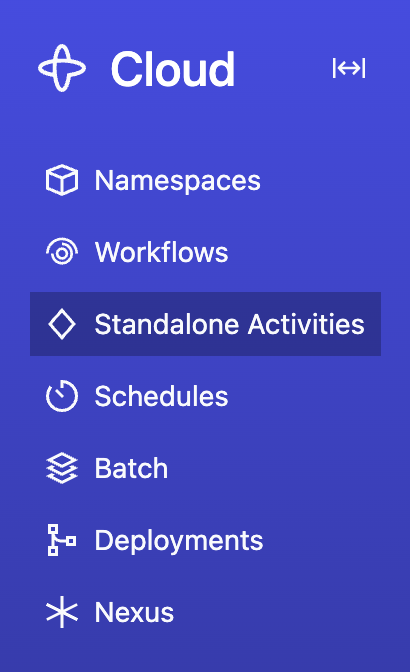
The Temporal Server will now be available for client connections on `localhost:7233`, and the
Temporal Web UI will now be accessible at [http://localhost:8233](http://localhost:8233). Standalone
Activities are available from the nav bar item located towards the top left of the page:
 Clone the [samples-java](https://github.com/temporalio/samples-java) repository to follow along:
```bash
git clone https://github.com/temporalio/samples-java.git
cd samples-java
```
The sample consists of separate programs in the `standaloneactivities` package:
```
core/src/main/java/io/temporal/samples/standaloneactivities/
├── GreetingActivities.java # Activity interface
├── GreetingActivitiesImpl.java # Activity implementation
├── StandaloneActivityWorker.java # Worker that processes activity tasks
├── ExecuteActivity.java # Starts an activity and waits for the result
├── StartActivity.java # Starts an activity without blocking
├── ListActivities.java # Lists activity executions
└── CountActivities.java # Counts activity executions
```
## Define your Activity
An Activity in the Temporal Java SDK is an interface annotated with `@ActivityInterface`, with
methods annotated with `@ActivityMethod`. The way you define a Standalone Activity is identical to
how you define an Activity orchestrated by a Workflow. In fact, the same Activity can be executed
both as a Standalone Activity and as a Workflow Activity.
[GreetingActivities.java](https://github.com/temporalio/samples-java/blob/main/core/src/main/java/io/temporal/samples/standaloneactivities/GreetingActivities.java)
```java
@ActivityInterface
public interface GreetingActivities {
@ActivityMethod
String composeGreeting(String greeting, String name);
}
```
[GreetingActivitiesImpl.java](https://github.com/temporalio/samples-java/blob/main/core/src/main/java/io/temporal/samples/standaloneactivities/GreetingActivitiesImpl.java)
```java
public class GreetingActivitiesImpl implements GreetingActivities {
private static final Logger log = LoggerFactory.getLogger(GreetingActivitiesImpl.class);
@Override
public String composeGreeting(String greeting, String name) {
log.info("Composing greeting...");
return greeting + ", " + name + "!";
}
}
```
## Run a Worker with the Activity registered
Running a Worker for Standalone Activities is the same as running a Worker for Workflow Activities —
you create a `WorkerFactory`, register the Activity implementation, and call `factory.start()`. The
Worker doesn't need to know whether the Activity will be invoked from a Workflow or as a Standalone
Activity. See [How to run a Worker](/develop/java/workers/run-worker-process) for more details on
Worker setup and configuration options.
[StandaloneActivityWorker.java](https://github.com/temporalio/samples-java/blob/main/core/src/main/java/io/temporal/samples/standaloneactivities/StandaloneActivityWorker.java)
```java
ClientConfigProfile profile = ClientConfigProfile.load();
WorkflowServiceStubs service =
WorkflowServiceStubs.newServiceStubs(profile.toWorkflowServiceStubsOptions());
WorkflowClient client = WorkflowClient.newInstance(service, profile.toWorkflowClientOptions());
WorkerFactory factory = WorkerFactory.newInstance(client);
Worker worker = factory.newWorker(TASK_QUEUE);
worker.registerActivitiesImplementations(new GreetingActivitiesImpl());
factory.start();
System.out.println("Worker running on task queue: " + TASK_QUEUE);
```
Open a new terminal, navigate to the `samples-java` directory, and run the Worker:
```bash
./gradlew -q execute -PmainClass=io.temporal.samples.standaloneactivities.StandaloneActivityWorker
```
Leave this terminal running — the Worker needs to stay up to process activities.
## Execute a Standalone Activity
Use
[`ActivityClient.execute()`](https://www.javadoc.io/doc/io.temporal/temporal-sdk/latest/io/temporal/client/ActivityClient.html)
to execute a Standalone Activity and block until it completes. Call this from your application code,
not from inside a Workflow Definition. This durably enqueues your Standalone Activity in the Temporal
Server, waits for it to be executed on your Worker, and then returns the typed result.
[ExecuteActivity.java](https://github.com/temporalio/samples-java/blob/main/core/src/main/java/io/temporal/samples/standaloneactivities/ExecuteActivity.java)
```java
ActivityClient client =
ActivityClient.newInstance(
service,
ActivityClientOptions.newBuilder().setNamespace(profile.getNamespace()).build());
StartActivityOptions options =
StartActivityOptions.newBuilder()
.setId(ACTIVITY_ID)
.setTaskQueue(TASK_QUEUE)
.setStartToCloseTimeout(Duration.ofSeconds(10))
.build();
String result =
client.execute(
GreetingActivities.class,
GreetingActivities::composeGreeting,
options,
"Hello",
"World");
System.out.println("Activity result: " + result);
```
The typed `execute()` API takes the Activity interface class and an unbound method reference. The SDK
uses the method reference to infer the Activity type name and result type at runtime. You can also
call Activities by string type name:
```java
// Using a string type name
String result = client.execute("ComposeGreeting", String.class, options, "Hello", "World");
```
`StartActivityOptions` requires `id`, `taskQueue`, and at least one of `startToCloseTimeout` or
`scheduleToCloseTimeout`.
To run it:
1. Make sure the Temporal Server is running (from the [Get Started](#get-started) step above).
2. Make sure the Worker is running (from the [Run a Worker](#run-worker) step above).
3. Open a new terminal, navigate to the `samples-java` directory, and run:
```bash
./gradlew -q execute -PmainClass=io.temporal.samples.standaloneactivities.ExecuteActivity
```
Or use the Temporal CLI:
```bash
./temporal activity execute \
--type ComposeGreeting \
--activity-id standalone-activity-id \
--task-queue standalone-activity-task-queue \
--start-to-close-timeout 10s \
--input '"Hello"' \
--input '"World"'
```
## Start a Standalone Activity without waiting for the result
Starting a Standalone Activity means sending a request to the Temporal Server to durably enqueue
your Activity job, without waiting for it to be executed by your Worker.
Use
[`ActivityClient.start()`](https://www.javadoc.io/doc/io.temporal/temporal-sdk/latest/io/temporal/client/ActivityClient.html)
to start a Standalone Activity and get a handle without waiting for the result:
[StartActivity.java](https://github.com/temporalio/samples-java/blob/main/core/src/main/java/io/temporal/samples/standaloneactivities/StartActivity.java)
```java
ActivityHandle handle =
client.start(
GreetingActivities.class,
GreetingActivities::composeGreeting,
options,
"Hello",
"World");
System.out.println("Started activity ID: " + ACTIVITY_ID);
// Wait for the result later
String result = handle.getResult();
System.out.println("Activity result: " + result);
```
With the Temporal Server and Worker running, open a new terminal in the `samples-java` directory and
run:
```bash
./gradlew -q execute -PmainClass=io.temporal.samples.standaloneactivities.StartActivity
```
Or use the Temporal CLI:
```bash
./temporal activity start \
--type ComposeGreeting \
--activity-id standalone-activity-id \
--task-queue standalone-activity-task-queue \
--start-to-close-timeout 10s \
--input '"Hello"' \
--input '"World"'
```
## Get a handle to an existing Standalone Activity
Use `client.getHandle()` to create a typed handle to a previously started Standalone Activity:
```java
ActivityHandle handle =
client.getHandle("standalone-activity-id", null, String.class);
```
Pass `null` as the run ID to target the latest run of the given activity ID. You can then use the
handle to wait for the result, describe, cancel, or terminate the Activity.
## Wait for the result of a Standalone Activity
Under the hood, calling `client.execute()` is the same as calling `client.start()` to durably
enqueue the Standalone Activity, and then calling `handle.getResult()` to block until the Activity
completes and return the result:
```java
String result = handle.getResult();
```
To wait asynchronously without blocking the calling thread, use `handle.getResultAsync()`, which
returns a `CompletableFuture`:
```java
CompletableFuture future = handle.getResultAsync();
```
Or use the Temporal CLI to wait for a result by Activity ID:
```bash
./temporal activity result --activity-id standalone-activity-id
```
## List Standalone Activities
Use
[`client.listExecutions()`](https://www.javadoc.io/doc/io.temporal/temporal-sdk/latest/io/temporal/client/ActivityClient.html)
to list Standalone Activity Executions that match a [List Filter](/list-filter) query. The result is
a `Stream` that fetches pages from the server on demand as the stream is
consumed.
These APIs return only Standalone Activity Executions. Activities running inside Workflows are not
included.
[ListActivities.java](https://github.com/temporalio/samples-java/blob/main/core/src/main/java/io/temporal/samples/standaloneactivities/ListActivities.java)
```java
client
.listExecutions("TaskQueue = '" + TASK_QUEUE + "'")
.forEach(
info ->
System.out.printf(
"ActivityID: %s, Type: %s, Status: %s%n",
info.getActivityId(), info.getActivityType(), info.getStatus()));
```
Run it:
```bash
./gradlew -q execute -PmainClass=io.temporal.samples.standaloneactivities.ListActivities
```
Or use the Temporal CLI:
```bash
./temporal activity list
```
The query parameter accepts the same [List Filter](/list-filter) syntax used for [Workflow
Visibility](/visibility). For example, `ActivityType = 'composeGreeting' AND Status = 'Running'`.
## Count Standalone Activities
Use
[`client.countExecutions()`](https://www.javadoc.io/doc/io.temporal/temporal-sdk/latest/io/temporal/client/ActivityClient.html)
to count Standalone Activity Executions that match a [List Filter](/list-filter) query. This returns
the total count of executions (running, completed, failed, etc.) — not the number of queued tasks.
It works the same way as counting Workflow Executions.
[CountActivities.java](https://github.com/temporalio/samples-java/blob/main/core/src/main/java/io/temporal/samples/standaloneactivities/CountActivities.java)
```java
ActivityExecutionCount resp = client.countExecutions("TaskQueue = '" + TASK_QUEUE + "'");
System.out.println("Total activities: " + resp.getCount());
resp.getGroups()
.forEach(
group ->
System.out.println("Group " + group.getGroupValues() + ": " + group.getCount()));
```
Run it:
```bash
./gradlew -q execute -PmainClass=io.temporal.samples.standaloneactivities.CountActivities
```
Or use the Temporal CLI:
```bash
./temporal activity count
```
## Run Standalone Activities with Temporal Cloud
The code samples on this page use `ClientConfigProfile.load()`, so the same code works against
Temporal Cloud — just configure the connection via environment variables or a TOML profile. No code
changes are needed.
For a step-by-step guide on connecting to Temporal Cloud, including Namespace creation, certificate
generation, and authentication setup in the Cloud UI, see
[Connect to Temporal Cloud](/develop/java/client/temporal-client#connect-to-temporal-cloud).
### Connect with mTLS
Set these environment variables with values from your Temporal Cloud Namespace settings:
```
export TEMPORAL_ADDRESS=..tmprl.cloud:7233
export TEMPORAL_NAMESPACE=.
export TEMPORAL_TLS_CLIENT_CERT_PATH='path/to/your/client.pem'
export TEMPORAL_TLS_CLIENT_KEY_PATH='path/to/your/client.key'
```
### Connect with an API key
Set these environment variables with values from your Temporal Cloud API key settings:
```
export TEMPORAL_ADDRESS=..tmprl.cloud:7233
export TEMPORAL_NAMESPACE=.
export TEMPORAL_API_KEY=
```
Then run the Worker and starter code as shown in the earlier sections.
Clone the [samples-java](https://github.com/temporalio/samples-java) repository to follow along:
```bash
git clone https://github.com/temporalio/samples-java.git
cd samples-java
```
The sample consists of separate programs in the `standaloneactivities` package:
```
core/src/main/java/io/temporal/samples/standaloneactivities/
├── GreetingActivities.java # Activity interface
├── GreetingActivitiesImpl.java # Activity implementation
├── StandaloneActivityWorker.java # Worker that processes activity tasks
├── ExecuteActivity.java # Starts an activity and waits for the result
├── StartActivity.java # Starts an activity without blocking
├── ListActivities.java # Lists activity executions
└── CountActivities.java # Counts activity executions
```
## Define your Activity
An Activity in the Temporal Java SDK is an interface annotated with `@ActivityInterface`, with
methods annotated with `@ActivityMethod`. The way you define a Standalone Activity is identical to
how you define an Activity orchestrated by a Workflow. In fact, the same Activity can be executed
both as a Standalone Activity and as a Workflow Activity.
[GreetingActivities.java](https://github.com/temporalio/samples-java/blob/main/core/src/main/java/io/temporal/samples/standaloneactivities/GreetingActivities.java)
```java
@ActivityInterface
public interface GreetingActivities {
@ActivityMethod
String composeGreeting(String greeting, String name);
}
```
[GreetingActivitiesImpl.java](https://github.com/temporalio/samples-java/blob/main/core/src/main/java/io/temporal/samples/standaloneactivities/GreetingActivitiesImpl.java)
```java
public class GreetingActivitiesImpl implements GreetingActivities {
private static final Logger log = LoggerFactory.getLogger(GreetingActivitiesImpl.class);
@Override
public String composeGreeting(String greeting, String name) {
log.info("Composing greeting...");
return greeting + ", " + name + "!";
}
}
```
## Run a Worker with the Activity registered
Running a Worker for Standalone Activities is the same as running a Worker for Workflow Activities —
you create a `WorkerFactory`, register the Activity implementation, and call `factory.start()`. The
Worker doesn't need to know whether the Activity will be invoked from a Workflow or as a Standalone
Activity. See [How to run a Worker](/develop/java/workers/run-worker-process) for more details on
Worker setup and configuration options.
[StandaloneActivityWorker.java](https://github.com/temporalio/samples-java/blob/main/core/src/main/java/io/temporal/samples/standaloneactivities/StandaloneActivityWorker.java)
```java
ClientConfigProfile profile = ClientConfigProfile.load();
WorkflowServiceStubs service =
WorkflowServiceStubs.newServiceStubs(profile.toWorkflowServiceStubsOptions());
WorkflowClient client = WorkflowClient.newInstance(service, profile.toWorkflowClientOptions());
WorkerFactory factory = WorkerFactory.newInstance(client);
Worker worker = factory.newWorker(TASK_QUEUE);
worker.registerActivitiesImplementations(new GreetingActivitiesImpl());
factory.start();
System.out.println("Worker running on task queue: " + TASK_QUEUE);
```
Open a new terminal, navigate to the `samples-java` directory, and run the Worker:
```bash
./gradlew -q execute -PmainClass=io.temporal.samples.standaloneactivities.StandaloneActivityWorker
```
Leave this terminal running — the Worker needs to stay up to process activities.
## Execute a Standalone Activity
Use
[`ActivityClient.execute()`](https://www.javadoc.io/doc/io.temporal/temporal-sdk/latest/io/temporal/client/ActivityClient.html)
to execute a Standalone Activity and block until it completes. Call this from your application code,
not from inside a Workflow Definition. This durably enqueues your Standalone Activity in the Temporal
Server, waits for it to be executed on your Worker, and then returns the typed result.
[ExecuteActivity.java](https://github.com/temporalio/samples-java/blob/main/core/src/main/java/io/temporal/samples/standaloneactivities/ExecuteActivity.java)
```java
ActivityClient client =
ActivityClient.newInstance(
service,
ActivityClientOptions.newBuilder().setNamespace(profile.getNamespace()).build());
StartActivityOptions options =
StartActivityOptions.newBuilder()
.setId(ACTIVITY_ID)
.setTaskQueue(TASK_QUEUE)
.setStartToCloseTimeout(Duration.ofSeconds(10))
.build();
String result =
client.execute(
GreetingActivities.class,
GreetingActivities::composeGreeting,
options,
"Hello",
"World");
System.out.println("Activity result: " + result);
```
The typed `execute()` API takes the Activity interface class and an unbound method reference. The SDK
uses the method reference to infer the Activity type name and result type at runtime. You can also
call Activities by string type name:
```java
// Using a string type name
String result = client.execute("ComposeGreeting", String.class, options, "Hello", "World");
```
`StartActivityOptions` requires `id`, `taskQueue`, and at least one of `startToCloseTimeout` or
`scheduleToCloseTimeout`.
To run it:
1. Make sure the Temporal Server is running (from the [Get Started](#get-started) step above).
2. Make sure the Worker is running (from the [Run a Worker](#run-worker) step above).
3. Open a new terminal, navigate to the `samples-java` directory, and run:
```bash
./gradlew -q execute -PmainClass=io.temporal.samples.standaloneactivities.ExecuteActivity
```
Or use the Temporal CLI:
```bash
./temporal activity execute \
--type ComposeGreeting \
--activity-id standalone-activity-id \
--task-queue standalone-activity-task-queue \
--start-to-close-timeout 10s \
--input '"Hello"' \
--input '"World"'
```
## Start a Standalone Activity without waiting for the result
Starting a Standalone Activity means sending a request to the Temporal Server to durably enqueue
your Activity job, without waiting for it to be executed by your Worker.
Use
[`ActivityClient.start()`](https://www.javadoc.io/doc/io.temporal/temporal-sdk/latest/io/temporal/client/ActivityClient.html)
to start a Standalone Activity and get a handle without waiting for the result:
[StartActivity.java](https://github.com/temporalio/samples-java/blob/main/core/src/main/java/io/temporal/samples/standaloneactivities/StartActivity.java)
```java
ActivityHandle handle =
client.start(
GreetingActivities.class,
GreetingActivities::composeGreeting,
options,
"Hello",
"World");
System.out.println("Started activity ID: " + ACTIVITY_ID);
// Wait for the result later
String result = handle.getResult();
System.out.println("Activity result: " + result);
```
With the Temporal Server and Worker running, open a new terminal in the `samples-java` directory and
run:
```bash
./gradlew -q execute -PmainClass=io.temporal.samples.standaloneactivities.StartActivity
```
Or use the Temporal CLI:
```bash
./temporal activity start \
--type ComposeGreeting \
--activity-id standalone-activity-id \
--task-queue standalone-activity-task-queue \
--start-to-close-timeout 10s \
--input '"Hello"' \
--input '"World"'
```
## Get a handle to an existing Standalone Activity
Use `client.getHandle()` to create a typed handle to a previously started Standalone Activity:
```java
ActivityHandle handle =
client.getHandle("standalone-activity-id", null, String.class);
```
Pass `null` as the run ID to target the latest run of the given activity ID. You can then use the
handle to wait for the result, describe, cancel, or terminate the Activity.
## Wait for the result of a Standalone Activity
Under the hood, calling `client.execute()` is the same as calling `client.start()` to durably
enqueue the Standalone Activity, and then calling `handle.getResult()` to block until the Activity
completes and return the result:
```java
String result = handle.getResult();
```
To wait asynchronously without blocking the calling thread, use `handle.getResultAsync()`, which
returns a `CompletableFuture`:
```java
CompletableFuture future = handle.getResultAsync();
```
Or use the Temporal CLI to wait for a result by Activity ID:
```bash
./temporal activity result --activity-id standalone-activity-id
```
## List Standalone Activities
Use
[`client.listExecutions()`](https://www.javadoc.io/doc/io.temporal/temporal-sdk/latest/io/temporal/client/ActivityClient.html)
to list Standalone Activity Executions that match a [List Filter](/list-filter) query. The result is
a `Stream` that fetches pages from the server on demand as the stream is
consumed.
These APIs return only Standalone Activity Executions. Activities running inside Workflows are not
included.
[ListActivities.java](https://github.com/temporalio/samples-java/blob/main/core/src/main/java/io/temporal/samples/standaloneactivities/ListActivities.java)
```java
client
.listExecutions("TaskQueue = '" + TASK_QUEUE + "'")
.forEach(
info ->
System.out.printf(
"ActivityID: %s, Type: %s, Status: %s%n",
info.getActivityId(), info.getActivityType(), info.getStatus()));
```
Run it:
```bash
./gradlew -q execute -PmainClass=io.temporal.samples.standaloneactivities.ListActivities
```
Or use the Temporal CLI:
```bash
./temporal activity list
```
The query parameter accepts the same [List Filter](/list-filter) syntax used for [Workflow
Visibility](/visibility). For example, `ActivityType = 'composeGreeting' AND Status = 'Running'`.
## Count Standalone Activities
Use
[`client.countExecutions()`](https://www.javadoc.io/doc/io.temporal/temporal-sdk/latest/io/temporal/client/ActivityClient.html)
to count Standalone Activity Executions that match a [List Filter](/list-filter) query. This returns
the total count of executions (running, completed, failed, etc.) — not the number of queued tasks.
It works the same way as counting Workflow Executions.
[CountActivities.java](https://github.com/temporalio/samples-java/blob/main/core/src/main/java/io/temporal/samples/standaloneactivities/CountActivities.java)
```java
ActivityExecutionCount resp = client.countExecutions("TaskQueue = '" + TASK_QUEUE + "'");
System.out.println("Total activities: " + resp.getCount());
resp.getGroups()
.forEach(
group ->
System.out.println("Group " + group.getGroupValues() + ": " + group.getCount()));
```
Run it:
```bash
./gradlew -q execute -PmainClass=io.temporal.samples.standaloneactivities.CountActivities
```
Or use the Temporal CLI:
```bash
./temporal activity count
```
## Run Standalone Activities with Temporal Cloud
The code samples on this page use `ClientConfigProfile.load()`, so the same code works against
Temporal Cloud — just configure the connection via environment variables or a TOML profile. No code
changes are needed.
For a step-by-step guide on connecting to Temporal Cloud, including Namespace creation, certificate
generation, and authentication setup in the Cloud UI, see
[Connect to Temporal Cloud](/develop/java/client/temporal-client#connect-to-temporal-cloud).
### Connect with mTLS
Set these environment variables with values from your Temporal Cloud Namespace settings:
```
export TEMPORAL_ADDRESS=..tmprl.cloud:7233
export TEMPORAL_NAMESPACE=.
export TEMPORAL_TLS_CLIENT_CERT_PATH='path/to/your/client.pem'
export TEMPORAL_TLS_CLIENT_KEY_PATH='path/to/your/client.key'
```
### Connect with an API key
Set these environment variables with values from your Temporal Cloud API key settings:
```
export TEMPORAL_ADDRESS=..tmprl.cloud:7233
export TEMPORAL_NAMESPACE=.
export TEMPORAL_API_KEY=
```
Then run the Worker and starter code as shown in the earlier sections.